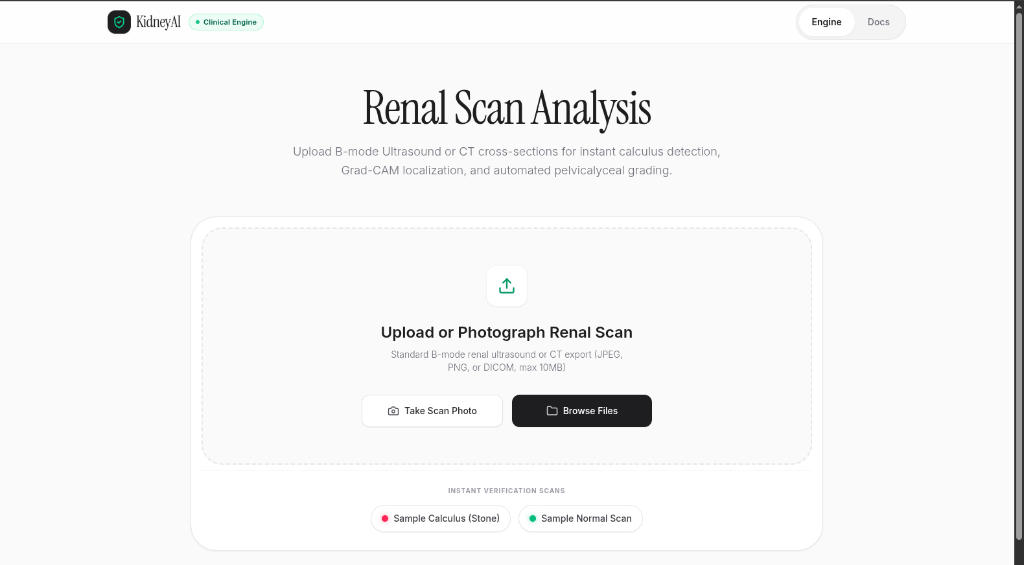
🩺 KidneyAI (NephroScan AI)
Clinical Production LiveA clinical-grade deep learning decision support system for rapid renal calculus detection, explainable AI (Grad-CAM saliency localization), and automated pelvicalyceal hydronephrosis grading from ultrasound and CT scans. Built with a 4-tier diagnostic architecture combining an Out-Of-Distribution (OOD) modality guard, MobileNetV2 inverted residual transfer learning, and real-time inference via an asynchronous FastAPI + Next.js microservice.
🔬 Key Innovations & Diagnostic Core
Enforces 4 physical acoustic gates (HSV Saturation, RGB Channel Divergence, Speckle Texture Laplacian variance, and Dynamic Contrast) to reject natural photography or non-medical images before tensor allocation, eliminating dangerous false-positive calculus detections.
Employs depthwise separable convolutions with inverted residual linear bottlenecks, achieving an 88.8% computational FLOP reduction for lightweight sub-50ms inference on CPU and bedside Point-of-Care Ultrasound (POCUS) deployments.
Computes feature-map gradients from the final convolutional layer (out_relu) and overlays an alpha-composited heatmap directly over the scan to visually verify calculus foci and acoustic shadows.
Translates calculus prediction confidence and spatial footprint into an automated 4-tier clinical obstruction risk model (Normal, Borderline, Moderate, and Acute Calculus with marked caliceal ballooning).
📊 Holdout Validation & Clinical Benchmarks (1,676 Scans)
| Classification Class | Precision | Recall (Sensitivity) | F1-Score | Specificity | Holdout Scans |
|---|---|---|---|---|---|
| Normal (No Stone) | 0.990 | 0.987 | 0.989 | 0.990 | 838 |
| Calculus (Stone Present) | 0.988 | 0.990 | 0.989 | 0.987 | 838 |
| Macro Weighted Average | 0.990 | 0.989 | 0.989 | 0.989 | 1,676 |